WARP — Web Answer Retrieval Protocol
WARP defines a fan-out-aware publishing architecture for concise, uniquely addressable publisher-authored answers, optional semantically distinct retrieval branches, precise supporting evidence and aligned machine-readable representations. It preserves the low-visual-noise WARP reading experience while adding deeper structure only when a reader or retrieval system needs it.
[a1]
The Web Answer Retrieval Protocol (WARP) is Eric Strate’s proposed publishing architecture for connecting concise publisher-authored answers to visible support and machine-readable structure. WARP adds optional nested fan-out questions and precise evidence targets so deeper retrieval paths can be addressed without making the default page visually busier.
[f1]What is a WARP fan-out node?
A WARP fan-out node is an optional, publisher-authored subquestion nested beneath a primary Answer Object. It represents a genuinely distinct information need that can be retrieved independently when additional context is useful.
Evidence ↗[f2]Why are fan-out questions kept inside the A citation?
Nested fan-out keeps the default reading experience as clean as WARP. Readers see the same small A citation unless they choose to open deeper related answers.
Evidence ↗[f3]Does WARP claim these are an AI system’s private queries?
No. WARP fan-out nodes are publisher-authored retrieval hypotheses. They describe useful semantic branches without claiming to reproduce the hidden queries or ranking logic of Google, ChatGPT or another system.
Evidence ↗What Is the Web Answer Retrieval Protocol?
The Web Answer Retrieval Protocol, or WARP, is a proposed method for publishing information in a form that remains useful to human readers while making important answers easier to identify, retrieve and reference independently. In WARP, an Answer Object can optionally contain semantically distinct fan-out questions when the subject has meaningful secondary retrieval needs.
WARP preserves the WARP presentation profile: the normal page still shows a small Answer Citation such as [a1]. Fan-out questions appear only inside that answer’s expanded panel, so additional machine structure does not increase default visual complexity.
Fan-out nodes are publisher-authored retrieval hypotheses, not claims about an AI system’s private query process. They should represent genuinely different information needs rather than paraphrases of the same question.
Each Answer Object and fan-out branch uses stable identifiers such as #a1 and #a1-f1. Evidence targets can use stable child identifiers such as #a1-f1-e1, allowing a consuming system to retrieve the smallest useful answer-and-evidence unit when it supports that behavior.
[a2]
WARP addresses the gap between long-form webpages and the concise answers retrieval systems often need by allowing publishers to identify important answers without separating those answers from the context and evidence that support them.
Link to this answerWhat Problem Does WARP Address?
Webpages are designed primarily as documents. A single page may contain navigation, introductions, examples, supporting explanations, images, footers and many separate facts. That structure is useful for a human reader but can make an individual answer difficult to reference precisely.
Search engines and retrieval systems already perform their own extraction, ranking and passage-selection processes. WARP does not attempt to replace those systems. It gives the publisher a consistent way to state: this is my concise answer, this is its stable identifier, this is the question it resolves, and this is the visible content that supports it.
A consuming system remains free to ignore that declaration, compare it with other information, retrieve additional context or decide that a different source is more appropriate.
[a3]
WARP starts its encoded map at the publisher’s canonical Answer Object, allows optional semantically distinct publisher-modeled fan-out intents beneath that answer, maps each F branch to visible addressable Evidence Objects, and keeps HTML, standard JSON-LD and the WARP protocol map aligned for validation.
[f1]What is the WARP retrieval hierarchy?
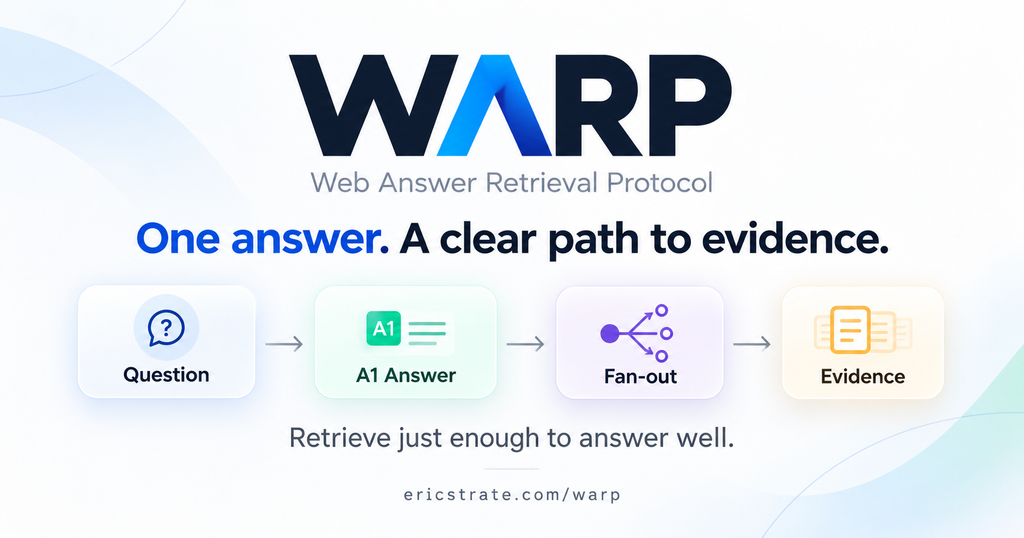
The WARP hierarchy is Answer Object → optional Fan-Out Question → focused answer → Evidence Object, with the visible HTML, semantic layer and WARP map kept aligned.
Evidence ↗[f2]How many fan-out questions should an answer have?
Only as many as represent materially different retrieval needs. WARP recommends a small set, commonly zero to five, and rejects redundant paraphrases as useful fan-out.
Evidence ↗[f3]What does minimum sufficient context mean?
Minimum sufficient context means retrieving the smallest answer-and-evidence unit that can resolve the current question accurately, while leaving unrelated branches unopened and unnecessary context unprocessed.
Evidence ↗How WARP Works
WARP separates the external user request from the encoded publishing structure. The USER QUESTION is conceptual because many surface phrasings may resolve to the same publisher answer. The machine-readable WARP map therefore starts at A.
USER QUESTION (conceptual, not encoded) → A canonical answer → F publisher-modeled fan-out intent → E visible evidence
The design goal is minimum sufficient context: a compatible system should be able to retrieve the smallest answer-and-evidence unit that resolves the current information need without requiring unrelated parts of the page.
Fan-out is optional. An Answer Object may have no fan-out nodes when the concise answer and support are sufficient. When fan-out is useful, WARP recommends a small set of semantically distinct branches, commonly zero to five, rather than repetitive query variants.
The F layer is publisher-authored retrieval metadata describing distinct information needs the page is prepared to resolve. These F nodes are hypotheses about useful retrieval branches, not a claim to reproduce the private fan-out queries, ranking logic or reasoning process of Google, ChatGPT or another system.
[a4]
A WARP Answer Citation is a visible identifier such as [a1] that corresponds to the stable fragment #a1, allowing the publisher, reader or compatible retrieval system to reference an individual answer within a larger page.
Link to this answerAnswer Citations and Stable Fragment IDs
The Answer Citation is the visible reference point for WARP. The notation is intentionally simple: [a1], [a2], [a3] and so on.
Each citation corresponds to a normal HTML fragment identifier such as #a1, #a2 or #a3.
This makes an answer addressable using ordinary web architecture. A URL such as https://ericstrate.com/warp/#a4 identifies a specific WARP Answer Object without requiring a new URL, proprietary endpoint or custom file format.
[a5]
A WARP Answer Object is a concise answer written or approved by the publisher. It summarizes the central fact or conclusion of a section while remaining consistent with the visible supporting content.
Link to this answerPublisher-Authored Answer Objects
The Answer Object must be publisher authored or publisher approved. Automated tooling may assist in drafting it, but the publisher remains responsible for the final answer and for keeping it consistent with the supporting content.
WARP recommends keeping an Answer Object short enough to function as a direct response. One concise paragraph is normally preferable, but WARP does not impose a fixed word or token count.
The Answer Object must not materially contradict, exaggerate or omit a qualification that would change the meaning of its supporting content.
[a6]
A WARP Evidence Object, identified as E, is a visible and uniquely addressable span of normal page content that materially supports an A or F answer. An E node does not have to be contained inside the F answer; it can remain in the page’s supporting content and be referenced by stable ID.
Link to this answerEvidence Objects, Supporting Content and Provenance
WARP deliberately does not replace long-form content with a collection of short answers. The supporting document remains the normal human-readable source.
An Evidence Object (E) gives a precise part of that visible support its own stable identifier, such as #a1-f1-e1. An F node can reference one or more E nodes when its concise answer needs evidence, qualification or deeper context.
E is a logical support relationship, not a requirement to duplicate the evidence inside the F answer. Keeping the evidence independently addressable allows a compatible retriever to select the concise F answer alone, F plus one E span, or additional evidence only when needed.
Every E reference used by WARP must resolve to exactly one visible DOM element. Hidden or schema-only evidence does not satisfy the WARP Evidence Object definition.
This relationship between concise answers and visible evidence is one of the primary differences between WARP and publishing disconnected hidden summaries solely for machines.
[a7]
WARP separates standard semantics from protocol-specific relationships. Valid Schema.org JSON-LD mirrors visible page and question-and-answer content, while a separate application/json WARP map records A → F → evidence relationships without inventing proprietary Schema.org properties.
[f1]What belongs in standard JSON-LD?
Standard JSON-LD should use valid Schema.org vocabulary for the page and visible question-and-answer content. WARP does not require inventing Schema.org properties for fan-out.
Evidence ↗[f2]What belongs in the WARP machine map?
The separate WARP application/json map expresses protocol-specific relationships such as parent Answer Objects, fan-out IDs, answer selectors and precise evidence targets.
Evidence ↗[f3]How are HTML, WARP JSON and JSON-LD kept aligned?
Stable identifiers connect the same visible question, answer and evidence across HTML, the WARP map and standard JSON-LD. A Semantic-profile implementation should validate that those representations remain substantively consistent.
Evidence ↗The JSON-LD and WARP Machine Layers
The machine-readable representation in WARP uses two coordinated layers rather than forcing every protocol relationship into Schema.org.
Standard semantic layer: valid Schema.org JSON-LD describes the page and visible answer content using established vocabulary. Existing WARP Answer Objects can continue to be represented with ItemList, ListItem and DefinedTerm; visible fan-out questions can additionally use valid Question and Answer entities.
WARP protocol map: a separate application/json block can express WARP-specific relationships such as the parent Answer Object, fan-out identifier, answer selector and exact evidence targets. The top level distinguishes spec, the canonical WARP specification URL, from page, the canonical URL of the implementation being described. This avoids pretending that a proprietary fanOut property is part of Schema.org.
Stable identifiers should align across the visible HTML, WARP map and semantic JSON-LD. The visible question and answer remain the source of truth; machine-readable representations must not introduce materially different claims.
[a8]
WARP favors existing Schema.org types such as ItemList, ListItem, DefinedTerm, Question and Answer when they accurately describe visible content, while protocol-specific fan-out relationships remain in the separate WARP map rather than invented Schema.org properties.
Link to this answerWhy WARP Uses Standard Schema.org Types
WARP does not require Schema.org, search engines or AI companies to recognize a new schema type called WARPAnswer or AnswerCitation.
Instead, WARP uses existing semantic concepts where they accurately describe the information being published.
The WARP behavior comes from the relationship among the query, visible Answer Citation, stable fragment ID, publisher-authored answer, supporting HTML and matching semantic object.
This keeps the protocol compatible with ordinary web publishing rather than making the page dependent on a proprietary content format.
[a9]
Token, retrieval and energy efficiency are design goals of WARP, not guaranteed outcomes. WARP is designed for selective retrieval of the minimum sufficient answer-and-evidence context, but actual token, latency, cost or energy savings depend on the consuming system.
[f1]How could WARP reduce unnecessary context?
A compatible retriever could select the relevant A or F branch and its evidence instead of processing unrelated sections of the page. That selective retrieval is the intended efficiency mechanism.
Evidence ↗[f2]Does adding more fan-out content automatically save tokens?
No. Extra fan-out that is repetitive or always retrieved could increase context. WARP therefore favors selective, semantically distinct branches rather than publishing every possible query variation.
Evidence ↗[f3]Can WARP claim energy savings?
Not without measurement by the consuming system. Lower token use, latency, cost or energy remain hypotheses and design goals, not guaranteed outcomes of publishing WARP markup.
Evidence ↗Token and Retrieval Efficiency as Design Goals
One motivation for WARP is the possibility that a compatible retrieval system could select a relevant Answer Object or fan-out branch and its precise evidence before passing a much larger amount of page content into an expensive processing step.
More markup or more fan-out content does not automatically improve efficiency. Repetitive branches or systems that always retrieve the entire page could increase context instead. WARP therefore favors selective, semantically distinct branches and progressive disclosure.
Token, latency, server-cost and energy reductions should not be presented as guaranteed results. Different crawlers and retrieval systems use different architectures, and some may ignore WARP completely.
WARP treats efficiency as a measurable hypothesis: if a consuming system can answer accurately from a smaller A or F branch plus its evidence, that system can compare the retrieved context with a conventional full-page or larger-chunk baseline.
[a10]
WARP may use cryptographic signatures or content hashes as an optional provenance extension, but cryptographic verification is not required for a basic WARP implementation.
Link to this answerOptional Cryptographic Provenance
A machine-readable answer can be copied, altered or separated from the page that originally published it. Cryptographic provenance is one possible way to address that problem.
WARP therefore allows future implementations to associate Answer Objects with signatures, content hashes or other established integrity mechanisms.
This remains an advanced and optional extension. A publisher does not need cryptographic infrastructure to implement WARP’s core relationship among queries, answers, stable identifiers, supporting content and semantic representation.
[a11]
WARP does not guarantee rankings, citations, AI visibility, lower computing costs or adoption by a search engine or AI company. It provides a publishing convention that consuming systems may choose to use.
Link to this answerWhat WARP Does Not Claim
WARP is intentionally narrow in what it claims to do.
It does not instruct Google, Bing, ChatGPT, Perplexity, Claude or another system which source to rank, retrieve or cite.
It does not create authority merely because a publisher labels something an answer, and it does not guarantee that an AI system will trust a publisher’s summary instead of independently analyzing the surrounding page.
It is not a Google ranking factor, a Schema.org standard or an industry-adopted specification.
[a12]
WARP is an experimental publishing architecture for AEO and machine retrieval that sits on top of traditional SEO. It does not replace crawlability, indexation, useful content, internal linking, authority or other established search fundamentals.
Link to this answerHow WARP Relates to SEO, AEO and GEO
WARP is most relevant to Answer Engine Optimization because it deals directly with identifying and addressing concise answers.
It can also be considered within Generative Engine Optimization because generative systems frequently use retrieved source material when constructing responses.
Neither changes the underlying requirement for good SEO. A WARP implementation on an inaccessible, unhelpful or untrusted page does not solve those problems.
This is why WARP is implemented on EricStrate.com as an additional information architecture rather than as a replacement for normal search optimization.
[a13]
A basic WARP implementation identifies the page’s primary query, maps important sections to stable Answer Objects and visible support, optionally nests semantically distinct fan-out questions beneath those answers, maps each fan-out to precise evidence, and keeps standard JSON-LD plus the WARP protocol map aligned with the visible HTML.
Link to this answerWARP Implementation Example
A simplified visible answer unit can be implemented with ordinary HTML:
<article
  data-warp-document="true"

  data-primary-intent="protocol definition">

  <div id="a1"
       data-warp="answer"
       data-support-ref="#support-a1">
    <details class="wacp-citation">
      <summary>[a1]</summary>
      <p>Primary concise answer...</p>

      <details id="a1-f1"
               data-warp="fanout"
               data-parent-answer="a1"
               data-evidence-ref="#a1-f1-e1">
        <summary>[f1] Related retrieval question</summary>
        <p id="a1-f1-answer">Focused fan-out answer...</p>
      </details>
    </details>
  </div>

  <p id="a1-f1-e1"
     data-warp-evidence="true"
     data-evidence-for="a1-f1">
    Visible supporting evidence...
  </p>
</article>
Standard JSON-LD should use established Schema.org vocabulary that matches the visible content. WARP-specific parent, fan-out and evidence relationships can be expressed separately in an application/json protocol map using the same stable identifiers. The actual USER QUESTION remains external to that map; optional query-intent metadata describes the information need rather than enumerating every possible phrasing.
[a14]
A conforming WARP page keeps stable Answer Objects and visible support, treats fan-out as optional and semantically distinct, maps any fan-out branch to precise evidence, and preserves consistency across visible HTML and any machine-readable representations the implementation exposes.
[f1]What is three-way consistency validation?
For WARP Semantic conformance, the visible HTML, the WARP application/json map and the standard JSON-LD should identify the same questions and materially consistent answers using stable IDs.
Evidence ↗[f2]How is fan-out diversity validated?
Fan-out branches should represent different information needs, not keyword or wording variants of one question. A validator can flag duplicate IDs and exact duplication, while semantic diversity still requires editorial judgment or a separate similarity check.
Evidence ↗[f3]Is the nested visual design required?
No. Progressive disclosure is the recommended WARP presentation profile because it preserves the low-noise WARP experience, but visual styling remains non-normative if the semantic relationships and accessibility remain intact.
Evidence ↗WARP Conformance Requirements
Required
- Identify one primary Answer Object and its broad query intent; do not treat one literal USER QUESTION string as exhaustive.
- Give every Answer Object a stable fragment identifier that is not reassigned to unrelated content.
- Associate each Answer Object with explicit visible support.
- Keep the concise answer materially consistent with its visible support.
- Keep the page useful if every WARP-specific data attribute is ignored.
- When fan-out is used, give each F branch a unique child identifier, a focused visible answer and at least one stable E target.
- Do not use fan-out solely to repeat keyword or wording variants of the same information need.
Semantic profile
A WARP Semantic implementation should maintain three-way consistency among the visible HTML, the WARP application/json map and standard JSON-LD wherever those layers represent the same question or answer. The WARP map begins at A rather than encoding the external USER QUESTION. Exact text mirroring is preferred for concise F answers; material semantic parity is required.
Fan-out diversity is a semantic requirement rather than a keyword-count rule. F branches are publisher-modeled retrieval intents and should resolve materially different information needs. Duplicate identifiers and exact duplicate questions are machine-checkable; deeper semantic redundancy may require editorial review or a similarity test.
Recommended citation presentation profile
WARP preserves the low-noise WARP presentation profile: small link-colored A markers with no decorative background. Fan-out questions are progressively disclosed inside the opened A panel and use smaller subordinate markers. Evidence identifiers do not need to be shown visually when an ordinary evidence link is sufficient. Styling remains non-normative.
Validator checks
- Every A, F and E identifier is unique in the rendered DOM.
- Every F identifies one valid parent A and one visible focused answer.
- Every E reference resolves to exactly one visible element; an E node may live outside the F answer.
- Each referenced E materially supports the F answer that points to it.
- Sibling F nodes represent distinct information needs rather than paraphrastic variants.
- The WARP map references only selectors and evidence IDs that actually exist in the HTML.
- The WARP map
pagevalue matches the implementation page’s canonical URL exactly;specidentifies the canonical WARP specification separately. - When standard JSON-LD represents an F question,
Question.namematches the visible F question andAnswer.textmatches the visible focused F answer. - For the Interactive profile, a direct F fragment such as
#a1-f1should reveal the parent A panel and the targeted F branch.
Conformance profiles
WARP Core covers the required visible HTML relationships. WARP Semantic adds aligned machine-readable representations and validation. WARP Interactive adds optional citation controls, nested fan-out interactions and tested accessibility behavior.
Optional
- Fan-out nodes when no meaningful secondary retrieval need exists.
- Cryptographic signatures or content hashes.
- Interactive citation popovers and hover behavior.
- Additional provenance metadata.
[a15]
WARP uses versioned specifications while keeping a permanent canonical web location. EricStrate.com/warp/ is the canonical specification page, while the open-source repository provides implementation documentation, examples and source-control history.
Link to this answerDevelopment and the Open Specification
The permanent canonical location of the Web Answer Retrieval Protocol is:
https://ericstrate.com/warp/
The public specification remains at one canonical URL. Revisions are documented in the protocol history rather than promoted as separate public versions.
WARP is also developed openly through the Web Answer Retrieval Protocol GitHub repository. Repository documentation and release history can evolve separately from the canonical web specification and should be synchronized when a new version is formally published.
[a16]
WARP retains the low-noise citation design and explicit Answer-to-Support mapping of WARP, then adds optional nested fan-out questions, precise evidence targets, minimum-sufficient-context guidance, selective-retrieval design goals and a separate protocol map alongside valid standard JSON-LD.
[f1]What does WARP preserve from earlier revisions?
WARP retains stable A citations, explicit Answer-to-Support mapping, validator-oriented conformance, semantic mirroring and the small low-noise citation presentation introduced in WARP.
Evidence ↗[f2]What does the current WARP architecture add?
WARP adds optional nested fan-out nodes, precise evidence targets, selective-retrieval design goals, minimum-sufficient-context guidance and a separate protocol map alongside valid standard JSON-LD.
Evidence ↗[f3]Why was the current WARP architecture piloted before broader deployment?
The 6.0 structure is being tested on the canonical WARP specification first so its visual behavior, semantic mappings and validation rules can be refined before wider implementation.
Evidence ↗What Changed in WARP?
WARP keeps the parts of 5.0 that are working well: stable [a1]-style citations, explicit Answer-to-Support mapping, validator-oriented conformance rules, semantic mirroring and a small background-free citation presentation that stays out of the reader’s way.
The new layer is hierarchical: A → F → E. An Answer Object may expose optional f1, f2 and similar publisher-modeled fan-out intents inside its expanded panel. Each F has its own focused answer and can point to one or more visible Evidence Objects identified with stable e1, e2 and similar IDs. WARP also formalizes selective retrieval and minimum sufficient context as design goals.
Machine-readable structure is split deliberately: standard JSON-LD uses valid established vocabulary, while the separate WARP map records protocol-specific A → F → evidence relationships. This avoids inventing unsupported Schema.org properties.
The current WARP architecture was piloted first on the canonical WARP specification page. The implementation remains experimental and does not claim that a search engine or AI system recognizes WARP, uses the same fan-out questions, or will rank or cite a page because WARP is present.
Protocol History
Earlier public revisions were published under the original WACP name. The numbered revisions are retained here as development history; the current public protocol is simply WARP.
Version 6.0 — September 2026
Added the A → F → E hierarchy: canonical Answer Objects, optional publisher-modeled fan-out intents and visible addressable Evidence Objects, plus selective-retrieval and minimum-sufficient-context design goals and a separate WACP protocol map alongside valid standard JSON-LD.
Preserved the WACP 5.0 low-noise visual presentation by placing fan-out interactions inside the existing A citation panel rather than adding new default markers throughout the page.
Added three-way consistency guidance for visible HTML, WACP JSON and standard JSON-LD, while keeping fan-out metadata explicitly publisher-authored and experimental.
Version 5.0 — September 2026
Added explicit Answer-to-Support mapping so each concise Answer Object can identify the visible support that explains, qualifies or evidences it.
Added validator-oriented conformance rules and named Core, Semantic and Interactive implementation profiles.
Added a recommended citation presentation profile: small, uniform, link-colored markers with no decorative background and a larger invisible interaction target.
Version 4.0 — September 2026
Added an explicit publisher-authored query graph connecting one primary query to legitimate fan-out questions, individual Answer Objects, visible supporting content and the matching semantic layer.
Added document-level metadata for the primary query and intent, plus answer-level metadata identifying query role and the question resolved by each Answer Object.
Retained the WACP 3.0 requirements for stable fragment identifiers, visible supporting context, accessible citation controls and semantic mirroring.
Version 3.0 — August 2026
Established the dual-layer implementation used across EricStrate.com: visible Answer Objects with stable fragment identifiers plus a matching semantic ItemList / ListItem / DefinedTerm representation.
Earlier versions
Earlier public drafts explored answer citations, semantic answer blocks, token-efficiency concepts and optional provenance extensions. Historical implementation material is preserved through the project’s source-control history.
WARP in Practice
This page is the first WARP pilot implementation. It preserves the WARP A-citation presentation while selected Answer Objects expose nested fan-out questions and precise evidence targets for testing before broader deployment.
WARP is also used on selected pages across EricStrate.com. Those implementations are experiments. Their presence does not imply adoption or endorsement by a search engine, AI company, Schema.org or automotive manufacturer.
WARP Specification Disclosure
The Web Answer Retrieval Protocol is an independent proposal created by Eric Strate. WARP is not endorsed by Google, Microsoft, OpenAI, Anthropic, Schema.org, the W3C or an automotive manufacturer. It is not a search ranking factor and does not guarantee inclusion, ranking or citation in search or AI-generated results. Performance and efficiency claims require empirical validation by the systems that consume WARP-formatted content.
WARP is also being tested on a deliberately unserious live experiment: the Best SEO Expert experiment .